Sign up for our Newsletter
Our monthly newsletter lists our upcoming events, reviews, news from the Town House, history features and snippets, plus a local exhibition listing.
Contact Us
The Regency Town House
13 Brunswick Square
Brighton & Hove
East Sussex
BN3 1EH, UK
1-6 Dudley Mews, was The Livery Stables
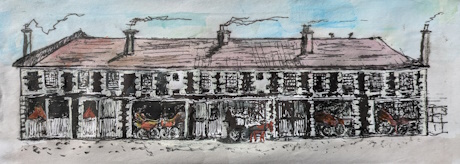
How the livery stables might have looked in the 1800s by Jill Vigus
At the bottom of Brunswick Street West there is a large building which looks like a terrace of half-a-dozen houses. The developers have named this block 1-6 Dudley Mews after the nearby apartment block, Dudley Mansions, on Lansdowne Road.
In the 1820s, however, this group of terraced houses was the main livery stables for this side of Brunswick Town and, along with the Market, would have been one of the largest buildings in the area.
1820s
The livery stables feature on Busby’s original plan behind the garden on which Lansdowne Mansions would be built. There would have been a demand for livery stables (shared public stables) from the residents in Brunswick Square who either didn’t have their own stables or who were just visiting for the season and therefore didn’t need permanent stabling facilities. Apart from No.1 Lansdowne Mansions, the other houses in Lansdowne Place weren’t built with stables at their rear so they would have used the same facility too.
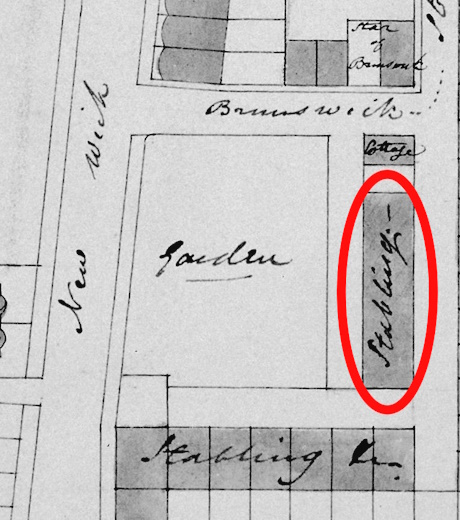
Segment of Busby’s 1825 map showing the site of the proposed livery stables to the right of the garden
Livery stables were common, where an owner could pay to have their horse stabled and fed, or horses could be hired. It’s likely that these livery stables followed the same model and also provided accommodation for the coachman and family above the stables where the owners’ horses were kept. As is often the case with servants, the coachmen and stable staff who lived above the stables are difficult to trace.
Livery stables typically had an owner who named the business but employed a foreman or stable keeper to run the day-to-day business of looking after and renting out the horses and carriages.
1840s
The Post Office directory for 1846, presumably compiled in 1845, shows Stephen Pannett as the livery stable keeper. However, by October 1846 this advert refers to Layzell’s Livery Stables and we know that the Layzell family lived in Lansdowne Cottage at the northern end of the stables. In 1851 John Layzell describes himself as an ostler, most likely looking after the horses of people visiting the inn opposite. John and his family remained in Lansdowne Cottage for the rest of their lives but they are always described as tailors. It’s unlikely that Layzell owned the stables but he may have managed them for a while.
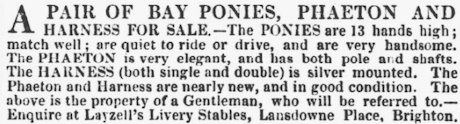
Layzell's Lansdowne Livery Stables – 1 October 1846 Brighton Gazette
1850s
There were several livery stables in the area and, during the 1840s, a John Egerton established himself as an owner of two: Kerrison Mews in Waterloo Street and Norfolk Mews in Brighton. John advertised his purchase of the Kerrison Mews stables in 1842.
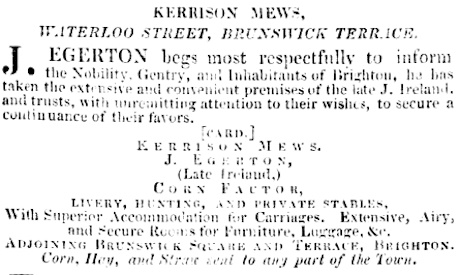
Egerton obtains Kerrison Mews stables - Brighton Gazette 21 July 1842
It appears that John Egerton chose to live at the stables in Waterloo Street as that’s where he appears in the 1851 census but by 1854, Taylors trade directory shows him as the owner of the Brunswick Street West livery stables.
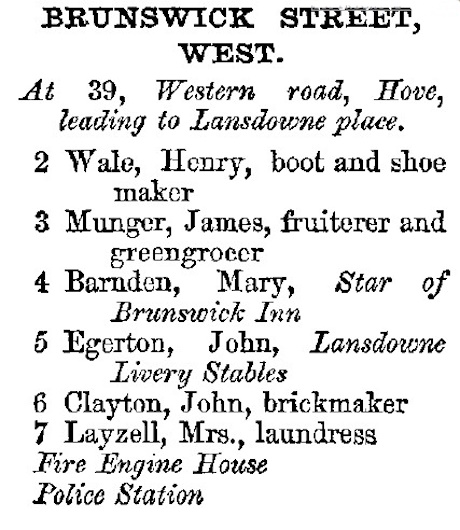
Taylors 1854 directory
The 1851 census enumerator finds James Matley at West Livery Yard, Brunswick Street after the residents of Lansdowne Cottage and before the coal yard. Over the years, the stables had several names but due to the position described by the census enumerator this is likely to be our livery stables. James is described as the stable keeper, likely an employee of the owner, possibly Stephen Pannett.
James is 45 years old and from London and is living here with his wife, three daughters and four sons. Being a stable keeper was a decent job and came with accommodation but there wouldn’t have been much room for nine people above the stables. James and Sophia’s first four children are born in London but by the birth of their third daughter, Mary Ann, in 1843, they’ve moved to Hove, presumably in search of better job prospects.
James had a few encounters with the law: twice as the injured party and once as a defendant.

Brighton Gazette 1 May 1845
James’s first encounter with the magistrates occurred when a young girl, Mary Ann Timms, had stolen a shawl belonging to James’ wife. She was sent to trial a few weeks later.

Brighton Gazette 22 May 1845
The punishment for Mary of six months hard labour seems unduly harsh. I suspect her main crime was one of being poor.
James’s second encounter was a more humorous affair. A customer, Edward Chilcott, had hired a fly from the stables but when he got to Steyning he couldn’t remember where he lived nor his girlfriend. On the way back, the carriage was involved in an accident and Chilcott decided that this was a good excuse not to pay the bill.
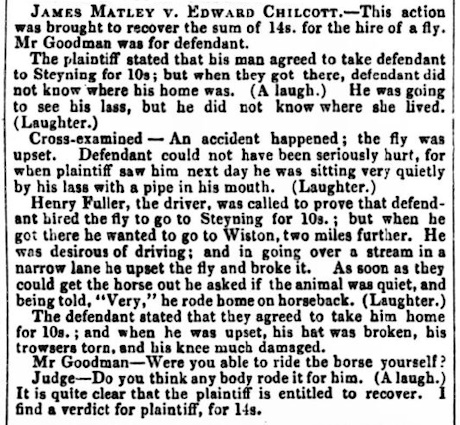
Brighton Gazette 27 May 1852
After hearing the story, the judge and jury had a good laugh and quickly awarded damages to Mr Matley.
Having enjoyed his previous visit to court earlier in the year, James was on the receiving end of justice later in 1852 when he was accused of mistreating a horse.
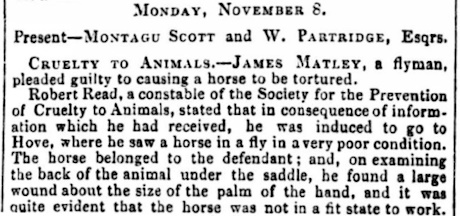
Brighton Gazette 11 November 1852
James blamed the coachman for using the wrong saddle but the judge decided that, as the stable keeper, James was ultimately responsible. He was fined 30 shillings including costs with half the fine going to the informer, the Society for Prevention of Cruelty to Animals.
At the 1851 census, there are very few other stablemen found at the livery stables so it may be that it wasn’t a thriving business at this point and within a couple of years the stables are offered for sale.
In March and April 1853, the following advertisement for three sets of properties appeared in the local newspapers:
HIGH VAULTS used as COW LODGES, with Buildings at end, and large Yard, enclosed by Folding Gates, situate in BRUNSWICK STREET WEST, HOVE, extensive Stabling over same, comprising three four-stall Stables, one three-stall ditto, two double Coach Houses, one large ditto for eight Carriages, large Lofts and Rooms over. Let on Lease to highly respectable Tenants, at £80 per annum. Also, a Cottage at the end, Let on a Yearly Tenancy of £15. The extent of this important range of buildings is 145ft. by 40ft. 3in.
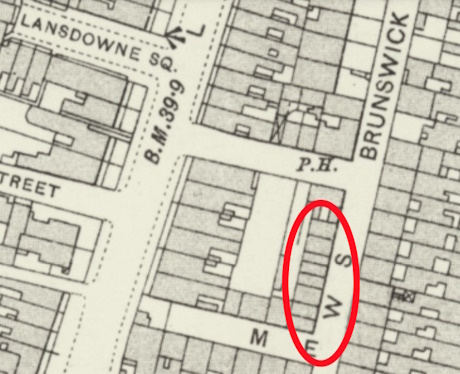
1890s OS map detail
The advert is describing the area in the south-west corner of Brunswick Street West to the east of the Garden (which became Lansdowne Mansions and then the Dudley Hotel, now Dudley Mansions).
The stabling became the Lansdowne Livery Stables. The stables were three storeys high and consisted of cow lodges below the Brunswick Street West street level (the ground drops off sharply behind), stabling and room for coaches on the ground floor with accommodation for staff above. The Cow Lodges presumably reflect the semi-rural location of the area when it was first constructed. A cow lodge was a shelter for the cows and, presumably, where they were milked. There were, of course, no fridges in those days so it made sense to have cows local for the provision of fresh milk.
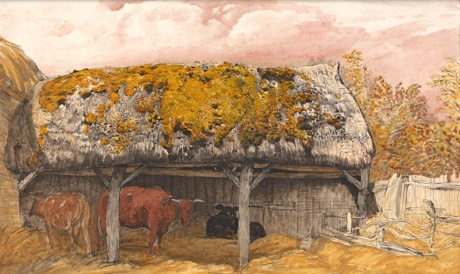
Cow Lodge with a Mossy Roof, c.1829 by Samuel Palmer
By 1853, John Egerton has taken over the stables and is selling a carriage and harness from there.
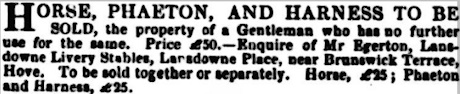
Egerton at Lansdown Livery Stables, Brighton Gazette - Thursday 15 December 1853
John remained a stable keeper for his whole life and at the age of 70 he was still describing himself as such while living at 39, Waterloo Street, Hove in the 1861 census. His son, also John, became a livery stable keeper too.
1860s
Egerton still owns the stables through the 1860s and appears in the list of Livery Stable owners in the trade directories although he’s living in Waterloo Street.
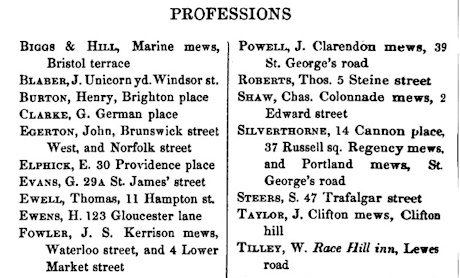
Folthorp's Directory & Court Guide of Brighton & Hove 1864
The livery stables seemed to attract legal action as there’s another incident in 1866.
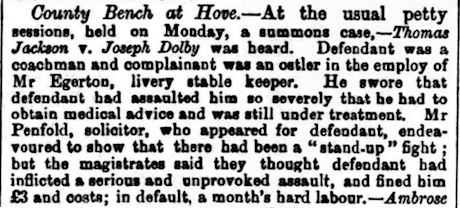
Brighton Guardian - Wednesday 19 December 1866
This time, John Egerton’s ostler was found to be the victim of an assault.
In 1868, Charles Bailey is the foreman for Egerton’s livery stables and he appears in court in a case of possible cruelty to one of the valuable horses stabled there. On this occasion there was insufficient evidence to prove the case.
1870s
The 1871 census lists the foreman of the livery stables, Charles Bailey, plus nine separate families in the rooms over the stables. The census describes Lansdowne Cottage as having a ‘Tailor’s shop’ attached. This would be consistent with the foreman living in Lansdowne Cottage, or maybe at the other end of the yard on the southern spur of the street, and the coachmen living above each stable. These domestic coachmen or grooms: James Haddock, Thomas Gregory, John Booth, William Williams, Charles Baldwin, George Cosner, Thomas Bull, George Budden and George Leach, are from all over the country from Sussex to Yorkshire.
In 1871, John Egerton is 80 years old and that might explain why the stables were sold a few years later.
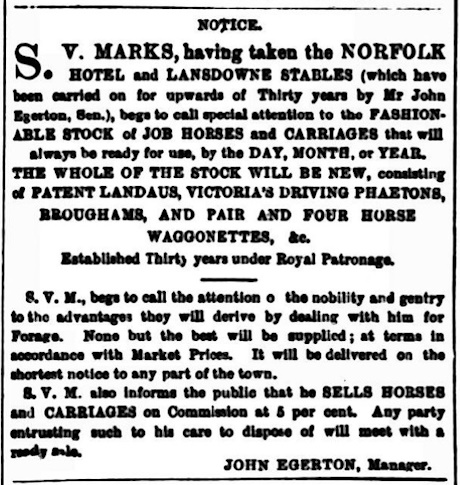
Brighton Gazette - Saturday 06 February 1875
The stables are sold by John Egerton to S.V. Marks in 1875 but the new owner appeared to struggle to generate enough business despite offering a 20% discount on the services provided.

Brighton Herald - Saturday 20 January 1877
The livery stables are for sale again in November 1877. They’re described as ‘Leasehold Stabling, Coach-houses and Buildings … also in the occupation of the Brighton Livery Stables Company’.
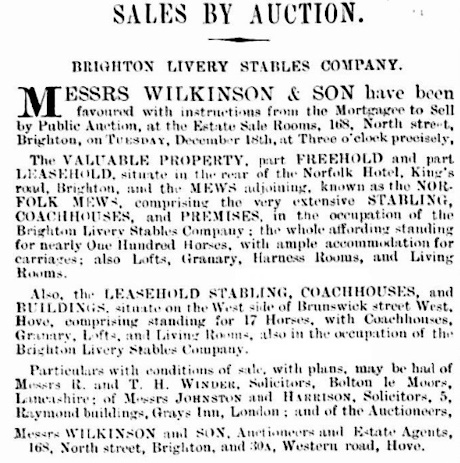
Livery Stables for sale – Brighton Guardian, 12 December 1877
The stables appear to have been bought by Samuel Young who runs other livery stables nearby. His son is managing the Brunswick Street West stables for him. The stables are clearly running out of customers, though.
1880s
Samuel Young presumably still owns the stables but his adverts in the 1880s only show him at other locations. Maybe the livery stables are unused from the mid-1880s until the conversion proposal in 1908.
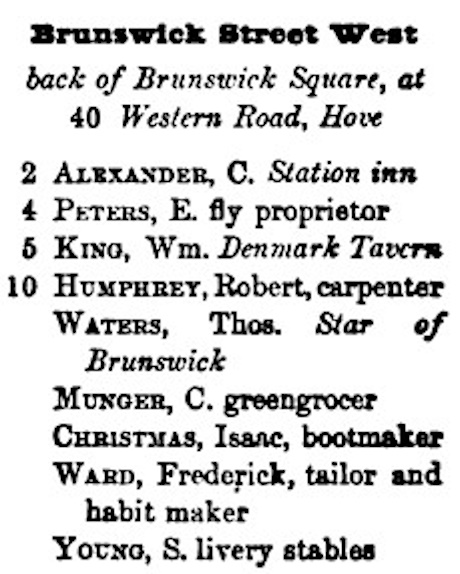
1884 Pages Directory showing Samuel Young’s livery stables still in Brunswick Street West
1890s
In the 1891 census, the Commissioner's Stores, Brunswick Street West are found. This is the yard behind the livery stables. The livery stables don’t get a mention so presumably they remain empty.
1900s
During the early 1900s the use of horse-drawn transport is diminishing, partly due to the railway and public buses and partly due to the arrival of motor vehicles. In 1908 there are unrealised plans to convert the stables into living accommodation and garages for private cars. The structure of the building and the arches in the basement are still visible.
The 1908 plans show the west elevation of the building which matches the description of the stables, accommodation and cow lodges in the 1853 advertisement.
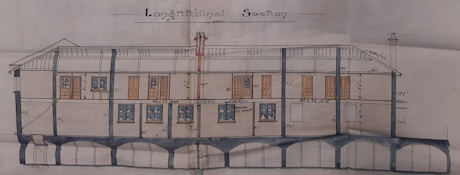
1908 elevation of proposed conversion of the livery stables. Plans from The Keep
By 1908 there had clearly been a reduction in the use of personal horse-drawn transportation and wealthier people were starting to own motor cars. Hence the proposed conversion from stables to garages and residential accommodation. These plans weren’t executed but some 90 years later the stables were converted.
1910s
Pikes Blue Book directory shows Samuel Young as the Livery Stable Keeper at Waterloo House, Waterloo Street and there is no mention of the Brunswick Street West stables elsewhere. They must have remained empty for quite a while.
1990s
In 1998 a planning application was made for the ‘Change of use and conversion of vacant garages into seven houses with associated parking in an adjacent underground car park in buildings to the rear of the Dudley Hotel, Brunswick Street West, Hove’.
The applications described the site as consisting of 11 garages with residential/storage use above, originally built in the mid-19th century as stables for the Dudley Hotel (not strictly true as they were built way before the Dudley Hotel appeared). More recently, the buildings have been used for storage, garaging, and housing plant/equipment, with only four units currently used for vehicle storage by non-local tenants.
The proposed development was for the conversion of the block into six two-bedroom and one three-bedroom houses, with designated underground parking spaces for each dwelling.
The two-bedroom units were intended for social housing while the three-bedroom unit was for private sale.
Coming up to date
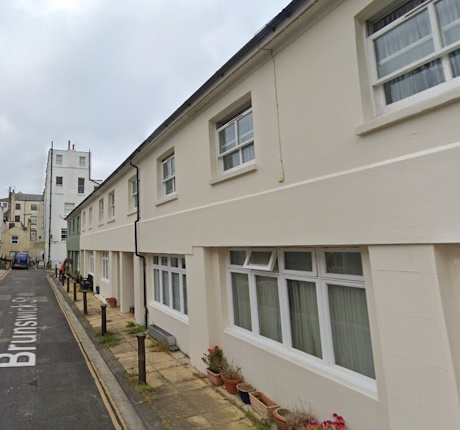
The former livery stables, now 1-6 Dudley Mews, Brunswick Street West
The building still looks the same shape and size as the 1908 plans indicate. The hipped roof is still in place – as seen by Google Earth - so it is probably essentially the same building.
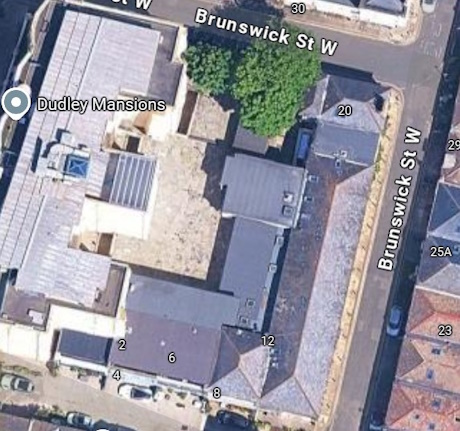
Google Earth view of Dudley Mews showing the hipped roof
During my research of the stables, I was always intrigued to know how much of the original building remained from the 1820s but I never plucked up the courage to ask a resident to show me round. Fortunately, as I was coming to the end of my research in 2024, one of the basement flats came on the market and I was pointed at one of the estate agent’s photographs by a research colleague.
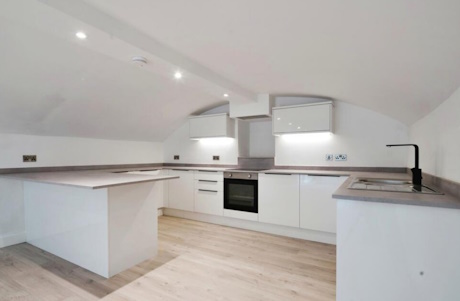
June 2024 Estate agent’s images of one of the flats still with the arched roof
I was pleased to see that the basement flats still have the curved roofs. I wonder if the residents realise that they’re living in the 1820s cow lodges!
Research by Kevin Wilsher, 2025
Return to Brunswick Street West page.