Sign up for our Newsletter
Our monthly newsletter lists our upcoming events, reviews, news from the Town House, history features and snippets, plus a local exhibition listing.
Contact Us
The Regency Town House
13 Brunswick Square
Brighton & Hove
East Sussex
BN3 1EH, UK
Brunswick Street East
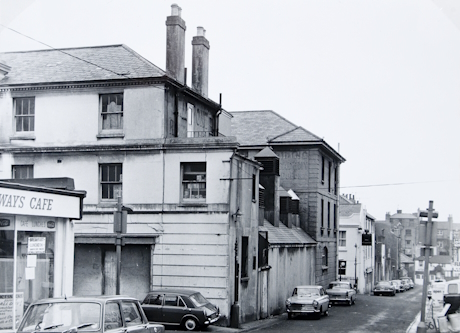
Brunswick Street East looking south in 1970. Credit: Regency Society James Gray Collection
Brunswick Street East came into being in the 1820s, tucked in behind the grand facades of Brunswick Terrace and the eastern side of Brunswick Square as their working, practical counterpart. This was a service street through and through — lined almost entirely with the stables and coach houses that belonged to the smart addresses out front. Not every house needed one, though: the 1870s OS map shows that numbers 7, 9, 23 and 24 Brunswick Square never had stables of their own, and may well have had gardens in their place instead.
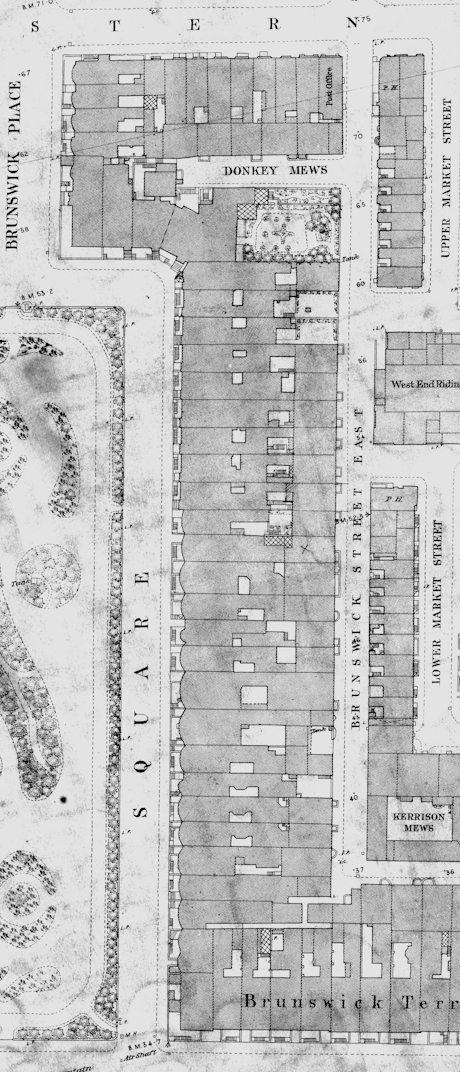
The area as shown on the 1870s OS map
Before 1922, the numbering here followed a rather charming — if impractical — logic: a stable simply took the number of the grand house it served. The stable behind 13 Brunswick Square, for instance, was itself number 13 Brunswick Street East. It's a tidy idea in principle, but it fell apart in practice, because the street doesn't run in a straight line — it bends eastward behind Brunswick Terrace, where the very same numbering habit was applied to the stables serving the Terrace houses. The result was two number 7s, two number 8s, and so on, right through to number 12. Had Brighton had postmen delivering to the street in that era, they'd have had quite a time of it.
The street didn't even have a settled name for much of the nineteenth century — it turns up in records as Market Street just as often as Brunswick Street. Somehow that muddle feels fitting for a street that never quite got its due.
For all that most of the houses on the east side of Brunswick Square came with a stable attached, plenty of them seem to have never been used for that purpose at all. As early as 1868, one was already doing duty as a storage space instead.

Brighton Gazette, 11 June 1868
That pattern held for decades. Stables kept being pressed into service as storage well into the 1900s, and now and then that created a genuine fire hazard on the street.
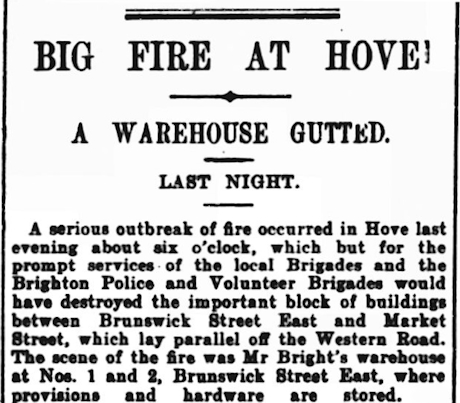
Brighton Gazette, 4 December 1902
From the turn of the twentieth century onward, the street's stables and coach houses were gradually reinvented — turned into garages, homes, or simple storage as the horse-drawn era faded. Even modern conveniences found their way in: by 1905 the street had acquired telephones.
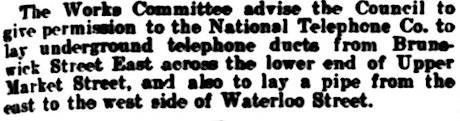
Brighton Gazette, 13 July 1905
In 1969, the street's story took a turn toward preservation, when it was brought within the Brunswick Town conservation area.
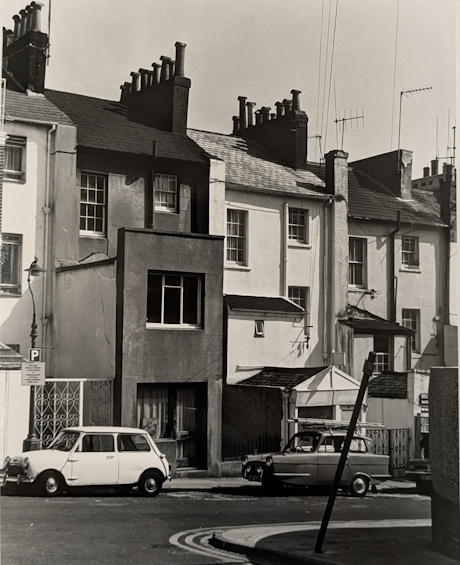
41, 43 and 45 Brunswick Street East, looking east towards Market Street, around 1975
Research by Kevin Wilsher, 2026
If you're interested in getting involved with our history research, please contact the project leader at kevin@rth.org.uk
Return to Brunswick Town page.