Sign up for our Newsletter
Our monthly newsletter lists our upcoming events, reviews, news from the Town House, history features and snippets, plus a local exhibition listing.
Contact Us
The Regency Town House
13 Brunswick Square
Brighton & Hove
East Sussex
BN3 1EH, UK
38 Brunswick Street East, formerly 14
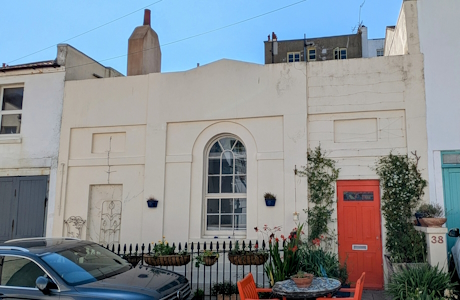
38 Brunswick Street East in 2026
Walk down Brunswick Street East today and most of the buildings still whisper their past as stables and coach houses — you can see it in the shape of the doorways, the height of the arches, the ghost of a working life that's long since moved on. Number 38 is the odd one out. Somewhere along the way it was rebuilt so completely that every trace of its old coach doors and stable entrance has vanished. You'd never guess, looking at it now, that this was once number 14 — the stable block belonging to the grand house at 14 Brunswick Square. The street was renumbered in 1922, when the old system was finally judged too confusing to live with any longer, and 14 quietly became 38.
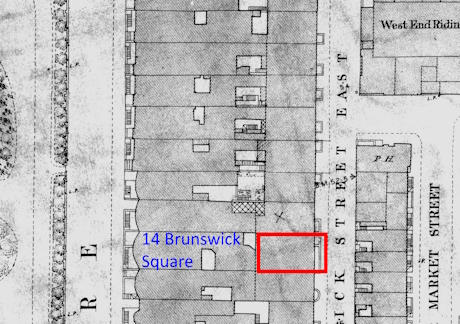
14 Brunswick Street East, as it appears on the 1875 OS map
The 1875 Ordnance Survey map settles one question straight away: this building was built as a stable. What it doesn't tell you is that, across two centuries, it seems to have spent surprisingly little time actually being used as one. In order to understand what was going on with the building, this history has had to look at what was happening with the main house, 14 Brunswick Square, as well as the rest of Brunswick Street East.
Service streets like this one have always been hard to research. The people who compiled Brighton's street directories, and even the census enumerators who came knocking every ten years, didn't think stables were worth much attention. In 1851 the census taker didn't even bother recording the stable numbers. Most nineteenth-century directories mention only a handful of buildings on the street by name — everything else gets lumped together as "private stables," a shrug in printed form.
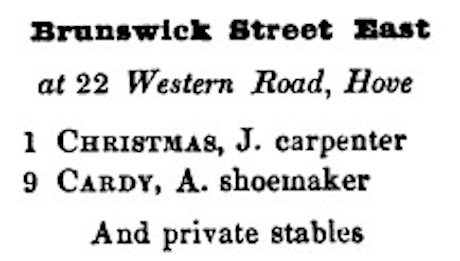
Folthorp's 1864 Brighton Directory
For most of the 1800s, 14 Brunswick Square belonged to the Stanford family, who leased it out to a string of tenants. When the census was taken on 6 June 1841, Catherine Desart was living in the main house with several servants — none of whom appear to have had anything to do with horses. A month later the lease passed from William Stanford to William Colegrave, and the paperwork — a little confusingly — describes the house, stables and coach houses as being in Market Street rather than Brunswick Street East. Colegrave stayed until 1846, though whether he ever used the stables is anyone's guess. George Butler took over next, and stayed through both the 1851 and 1861 censuses. Once again, for all his servants, none seem to have been in the business of looking after horses or carriages.
It's not until the 1871 census that we get our first real hint that the stables might be earning their keep. The building itself still goes unmentioned — presumably because it was standing empty — but over in the main house there's a 19-year-old groom named George Marchant, newly arrived from Eastbourne. No coachman is recorded alongside him, but somewhere, presumably, George was tending his employer's horses.
A few years on, in 1877, Ellen Stanford — wife of Vere Fane Benett Stanford — leased the house and stables to Samuel Pratt. By now the lease has been corrected to describe the stables as being in Brunswick Street (although missing the ‘East’), where they actually were.
By 1881 Sir Charles Oakley and his family were installed in the main house with their servants, but again there's no sign of anyone next door in the stables. Before the decade was out, the house had a new life altogether — as a technical college for ladies.
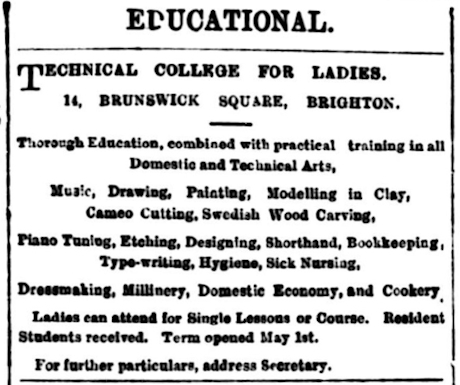
Brighton Gazette, Saturday 25 May 1889 — 14 Brunswick Square in use as a school
The school didn't last. A couple of years later the house stood almost empty, home only to a single servant, Harriet Beale, presumably keeping watch over it on the owners' behalf. With the main house essentially unoccupied, the stables sat idle too, just as you'd expect.
Somewhere around this point the stable was cut loose from the main house altogether — though exactly when is impossible to say. By the early 1890s, at least one of the Brunswick Street East stables had been leased out to an entirely separate property: number 30 Brunswick Square, on the far side of the square.
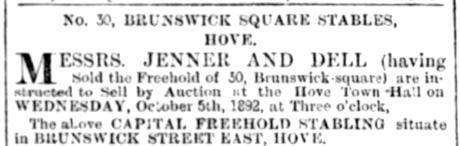
Sussex Daily News, Tuesday 27 September 1892 — the stables sold separately
Ownership of the house and stables shifted again by the end of the 1890s. The main house became a boarding house — a change of use that seems to have gone down badly with the neighbours. There was no stable staff to speak of, and little reason to think anyone was using the stables at all.
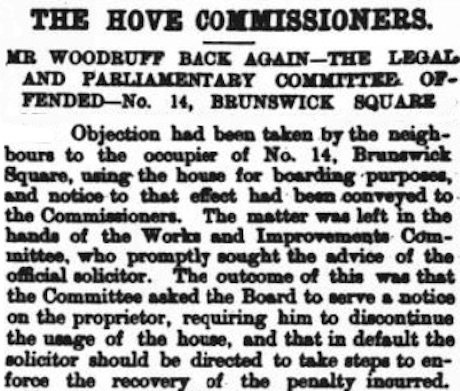
Brighton Gazette, Saturday 14 October 1893
In 1894, number 14 Brunswick Square was sold — without the stable.
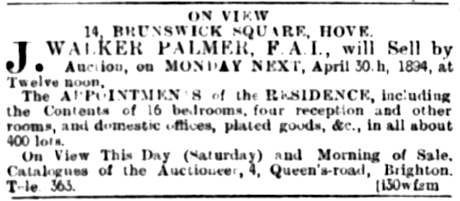
Sussex Daily News, Saturday 28 April 1894 — sale of 14 Brunswick Square
By 1897, Towner's Brighton Directory doesn't mention number 14 Brunswick Square at all, presumably because the house stood empty. A year later it was let to a Mrs Annie Emma Whitlark, by which point the Stanford family no longer owned it. The lease refers to "yard and outbuildings" — but pointedly not to stables or a coach house. It looks very much as though those had already been sold off separately.
Then, in 1901, comes the one moment in two hundred years when the record actually shows this building doing the job it was built for. In the main house, George Rhodes, a retired policeman, was living with his wife — acting as caretaker — and his daughter, a milliner, presumably minding the property for an absent owner. And in the stable itself, at last someone: Charles Seabourn, a coachman, apparently with no connection to the house at all. By 1905 he'd moved three doors down to number 11, perhaps working freelance by then.
Charles Seabourn's own story reaches back to rural Herefordshire, where he was born around 1852. Like so many who came to Sussex looking for a better living, he made his way to Hove to work in service. In 1901 he was living above the coach house and stables with his wife Harriett, their son Cyril, and two daughters, Winifred and Constance — a whole family's life playing out above the horses.
Stables elsewhere on the street were still in use in the early 1900s, though not always well kept. The courts occasionally had to step in and remind owners to muck out.
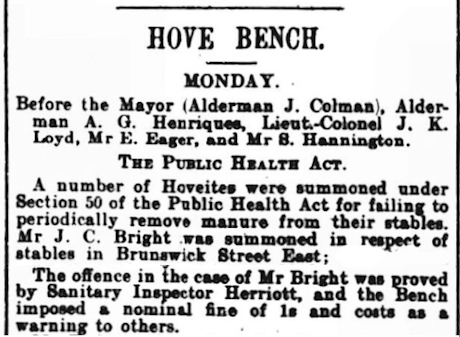
Brighton Gazette, Thursday 1 May 1902 — order for the removal of manure from stables
Not all the drama on the street was equine. In July 1905, just four doors along, a cab-proprietor named James Bartlett took his own son to court over an ugly bout of verbal abuse and threats. The son, Alfred, laid the blame squarely back on his father. The magistrate, wanting no part of a family feud, dismissed the case outright.
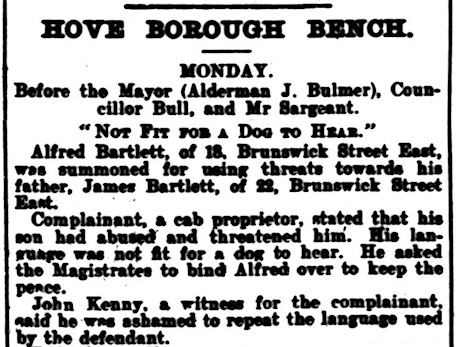
Brighton Gazette, 8 July 1905
By 1911 the street was changing shape as horses gave way to cars and buses. A few coachmen held on, but chauffeurs had begun to appear alongside them. Number 14 goes unmentioned in the directories of the period, so what became of it is anyone's guess — quite possibly it stood empty, or was pressed into use for storage.
The silence continues in 1915: number 14 still isn't listed, though its neighbours are — 13 occupied, 15 home to a taxi-cab proprietor, and a planning application in for turning number 11 into a motor garage.
Then, in 1922, the street was renumbered, and 14 became 38 — the number it still carries today.
By 1947 the street's quiet, unremarkable character continues: there's a plan to use number 32 as a cellulose store for the South Coast Sheet Metal Works. It's fair to say the road never lived a particularly thrilling life.
Our building itself disappears from the directories entirely until the 1960s. It may have stood empty the whole time, or simply been used for storage, much like other former stables nearby. By 1969, William Edwards was in residence, sharing the street with garages, lock-ups and taxicabs, and he was still there when the last street directory was printed in 1974.
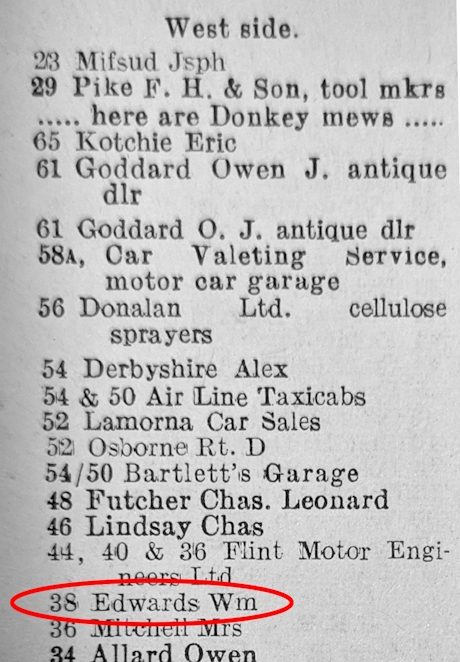
Kelly's Street Directory, 1969
Given how rarely this building was ever put to its intended use, it's no great surprise that it eventually became a home. Exactly when that happened remains a mystery — certainly it was some time before 2005, by which point the property looked all but derelict.
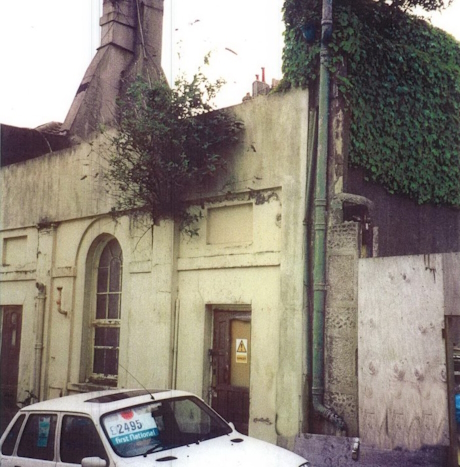
38 Brunswick Street East in 2005, prior to restoration
So there the trail runs cold: a stable that was barely ever a stable, converted to a house sometime between 1969 and 2005, at a date nobody has yet managed to pin down. The mystery continues.
Research by Kevin Wilsher, 2026
If you’re interested in getting involved with our history research, please contact the project leader at kevin@rth.org.uk
Return to Brunswick Street East page.